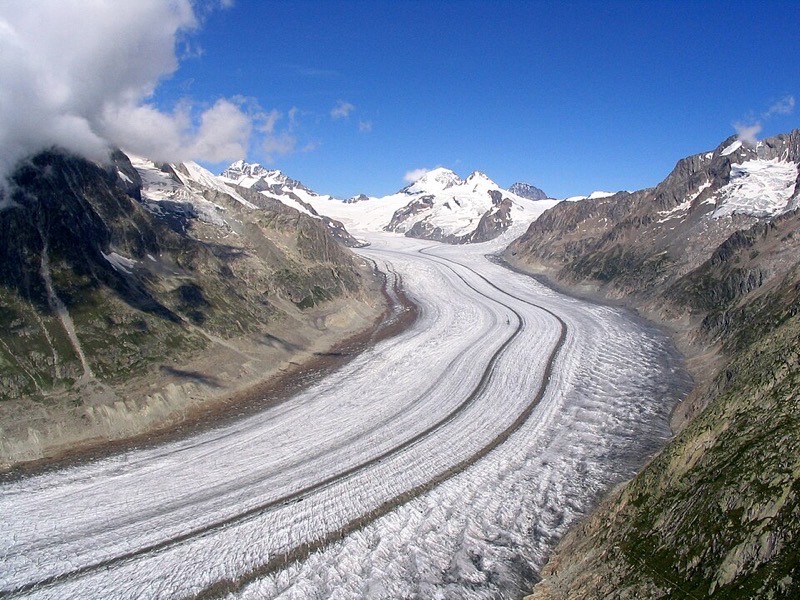
Switzerland holds roughly 1,400 glaciers, down from approximately 1,800 at the start of the twentieth century. The retreat is measurable year by year at most sites; the marked posts along the Morteratsch glacier walk record it in gravel. This is not a reason to avoid glacier viewpoints — it is a reason to go soon, and to go with accurate information about what you will actually see from each platform rather than decade-old marketing images. This guide covers the five most substantive glacier viewpoints accessible by public transport from Basel, Zurich or Geneva without specialist climbing equipment: the Aletsch Arena (Eggishorn and Bettmerhorn), Jungfraujoch with the Aletsch glacier from above, the Matterhorn Glacier Paradise above Zermatt, Diavolezza and the Morteratsch glacier in the Engadine, and Titlis above Engelberg.
Aletsch Arena: Eggishorn and Bettmerhorn
The Great Aletsch Glacier (Grosser Aletschgletscher) is the longest glacier in the Alps at approximately 23 kilometres, and the Aletsch Arena — the elevated plateau between the Rhone valley villages of Fiesch, Betten and Mörel — provides the two best terrestrial viewpoints over its upper reaches. Both are accessible by cable car from the Rhone valley floor and are reachable by train from the main SBB line at Brig or Visp.
Eggishorn (2,869 m) is the higher and more commanding viewpoint. From the summit, the glacier curves away to the north in a wide arc, with the Jungfrau, Mönch and Eiger visible on clear days at the far end of the ice field some 23 kilometres distant. The Eggishorn cable car departs from Fiesch station (reachable from Brig on the Matterhorn Gotthard Bahn in approximately 35 minutes). A return ticket from Fiesch to Eggishorn costs CHF 38 for adults; children aged 6–15 pay CHF 21. The Swiss Travel Pass does not cover this cable car, but the Half Fare Card gives a 50 percent reduction to CHF 19 return. The final section above Fiescheralp involves a 15-minute walk or a second gondola stage; allow a full half-day for the ascent, time at the top and descent.
Bettmerhorn (2,647 m) gives a slightly lower perspective over the glacier, with the advantage of direct access from Bettmeralp — a car-free village reached by cable car from Betten station (on the Brig–Visp axis). The Bettmerhorn cable car return from Bettmeralp costs CHF 26 for adults. The glacier edge at Bettmeralp is accessible on foot from the village in around 45 minutes on a marked alpine trail, offering a direct encounter with the ice margin rather than just a distant panorama. This is the editorial desk's recommended option for visitors who want both a viewpoint and close contact with the glacier in one day. The village of Bettmeralp has four or five small hotels and a collective of mountain restaurants; it is a functional place to stay overnight rather than a resort.
Jungfraujoch: Top of Europe and the Aletsch from Above
Jungfraujoch (3,454 m) is the highest railway station in Europe and occupies a saddle between the Mönch and Jungfrau peaks at the top of a tunnel bored through the Eiger and Mönch by Adolf Guyer-Zeller between 1896 and 1912. The construction took 16 years, cost the lives of 30 workers, and produced a railway that remains the primary access to the Jungfrau plateau — the starting point of the Aletsch glacier. The view from the Sphinx observation terrace (3,571 m, accessed by elevator from within the station) looks down the full length of the Aletsch glacier, which at this height is still broad, flat and white rather than the narrowed, debris-covered tongue it presents lower in the valley.
The journey to Jungfraujoch from Grindelwald involves the Wengernalpbahn (Grindelwald to Kleine Scheidegg) and then the Jungfraubahn (Kleine Scheidegg to Jungfraujoch). Total travel time from Grindelwald is 2 hours 15 minutes; from Interlaken Ost, add another 35 minutes. Adult full-price return from Grindelwald is CHF 235 (2025 price). Swiss Travel Pass holders receive a discount to approximately CHF 140.30 return; the exact amount varies with the tariff zone structure and it is worth confirming at the SBB counter. There is also a Good Morning Ticket for early departures (before 08:00 from Kleine Scheidegg) at a reduced rate of around CHF 165 for adults without a pass — confirmation that arriving early is both visually and financially advantageous.
At Jungfraujoch, the station complex contains two cafeteria restaurants, a post office (the highest in Europe), an ice palace with carved tunnels in the glacier, and outdoor terraces for those who can tolerate minus 5 to minus 15 degrees Celsius with wind. The indoor experience at the top is more extensive than visitors expect; allow at least 90 minutes at the summit. The intermediate stop at Eigergletscher (2,320 m) is worth a brief step outside: the sheer Eiger north face is directly above you and the scale is vertiginous in a way the postcards do not convey.
Matterhorn Glacier Paradise
The Matterhorn Glacier Paradise is the highest cable car station in the Alps at 3,883 metres, reached from Zermatt by a four-stage cable car system via Furi, Trockener Steg and the final stage to Klein Matterhorn. The journey from Zermatt takes approximately 30 minutes. The station offers the closest public-access view of the Matterhorn's summit pyramid from the same altitude as its base; the peak itself still rises another 580 metres above the cable car, but the visual mass of the mountain at this range is more impactful than any distant view from a valley floor.
The Glacier Palace, included in the cable car ticket, is a network of ice tunnels carved into the Theodul glacier beneath the station. The tunnels are lit and contain ice sculptures; the temperature inside is a constant minus 10 degrees Celsius. A summer ski area on the Theodul glacier is accessible from the same station, making it one of the few places in Switzerland where skiing is offered in July and August. Ski rental is available at Trockener Steg (CHF 45–60 per day for full adult ski equipment). Non-skiing visitors to the viewing platform and glacier palace pay CHF 100 return from Zermatt (adult, 2025). There is no Swiss Travel Pass discount on any Zermatt cable car; the Half Fare Card gives 50 percent off.
Zermatt itself is car-free, reachable by the Matterhorn Gotthard Bahn from Visp (45 minutes, on the main Brig–Göschenen–Andermatt axis) or by the direct Zermatt Express from Täsch, where cars must be left in the large paid parking facility (CHF 15.50 per day). The editorial desk notes that Zermatt is one of the most expensive places to eat and sleep in Switzerland; budget accommodation in Täsch or Visp and day-tripping by train reduces costs considerably without sacrificing the glacier visit itself.
Diavolezza and the Morteratsch Glacier
Diavolezza (2,978 m) is a cable car station above Pontresina in the Upper Engadine, directly overlooking the Pers glacier and, in the distance, the Morteratsch glacier below the Bernina massif (Piz Bernina, 4,049 m). The cable car departs from Diavolezza station on the Bernina railway — one stop south of Pontresina — making it directly reachable by the Bernina Express itself. A return ticket from the valley station costs CHF 39 for adults; Half Fare Card reduces this to CHF 20.
The classic Diavolezza experience in late summer is a ski touring or hiking descent across the Pers glacier to Morteratsch, a two- to three-hour route across open glacier that requires crampons and ideally a guide or local glacier knowledge. For visitors without this equipment, the viewing terrace at the Diavolezza mountain restaurant gives a clear view of both the Pers and Morteratsch glaciers and the full Bernina massif. This is one of Switzerland's most underrated glacier viewpoints: fewer visitors than Jungfraujoch or Zermatt, direct train access, and a genuinely dramatic landscape.
The Morteratsch glacier walk — from Morteratsch station to the current glacier snout — requires no cable car at all. The flat, marked path from the station takes 40 to 50 minutes one way. The retreat posts along the path are dated and spaced accurately; the furthest post, marking the glacier extent in 1900, is now over 2.5 kilometres from the current ice. This is one of the most direct ways to observe documented glacier retreat in a short walk. The path is gravel-surfaced and suitable for ordinary walking shoes; no fee or registration required.
Titlis: Engelberg
Titlis (3,020 m) is the main glacier viewpoint accessible from central Switzerland, reached from Engelberg — a valley village in Canton Obwalden, roughly one hour by train from Lucerne. The Titlis cable car system from Engelberg to the summit uses the Rotair gondola for the final 500 metres of elevation gain; the gondola rotates 360 degrees during the ascent, giving every passenger a full panorama. Adult return from Engelberg is CHF 96 (2025); children under 6 are free, children 6–15 pay CHF 48. The Half Fare Card halves the adult price; there is no Swiss Travel Pass discount.
At the summit, the Glacier Cave provides access inside the Titlis glacier via carved tunnels at minus 1 degree Celsius. The cliff walk — a suspension bridge extending out from the rocky face at 3,041 metres — is included in the cable car ticket and is one of the longest pedestrian suspension bridges at altitude in Europe. Snow tubing and a zipline are also available on the glacier terrace. The Titlis is more directly oriented toward family and recreational visitors than Jungfraujoch or Diavolezza, and the summit experience reflects this: there are more entertainment activities and the atmosphere is livelier. The glacier itself, while visible and accessible, is less dramatically large than the Aletsch or Morteratsch; Titlis is better understood as a high-alpine experience than a glacier study in depth.
For rail travellers based in Lucerne, the Titlis pairs naturally with a morning or afternoon on the lake by steamer (covered in our lakeside towns guide). From the same base, the Pilatus or Rigi rack railways offer lower-altitude alternatives without glacier access but with excellent ridge-walking above the cloud line on good days.
Glacier Viewpoints at a Glance
Eggishorn / Aletsch Arena
Panoramic overview of the full 23 km Great Aletsch Glacier. Cable car from Fiesch station. Return CHF 38 (adult); Half Fare CHF 19. Swiss Travel Pass not valid. Year-round, best May–October.
See travel passesJungfraujoch
Highest railway station in Europe. Aletsch glacier from above. Return from Grindelwald CHF 235 (full price) / CHF 140.30 (with Swiss Travel Pass). Year-round. Book early departure for clearer views.
Jungfraubahn detailsMatterhorn Glacier Paradise
Highest cable car in the Alps. Glacier Palace ice cave included. Return from Zermatt CHF 100 (adult). Half Fare Card 50% off. No Swiss Travel Pass discount. Year-round, ski area July–August.
Plan a Zermatt visitDiavolezza
Direct access via Bernina railway. Views over Pers and Morteratsch glaciers. Return CHF 39 (adult); Half Fare CHF 20. Year-round; summer walking, winter skiing.
Bernina Express routeMorteratsch Glacier Walk
Free, unguided walk from Morteratsch station. Marked retreat posts from 1900 onward. 45-minute flat path. No cable car required. Open year-round while path is clear of snow (approx. June–October).
Ask about EngadineTitlis, Engelberg
Rotair revolving gondola, cliff walk suspension bridge, glacier cave. Return from Engelberg CHF 96 (adult); Half Fare CHF 48. No Swiss Travel Pass discount. Year-round, best May–October for glacier access.
Combine with LucerneWeather, Timing and What to Bring
All five glacier viewpoints are subject to weather closures. Cable cars and rack railways do not operate in storms or very high winds; check the operator's website or phone the valley station on the morning of your planned visit. High-alpine cloud forms rapidly between June and August, often clearing by mid-morning if the day begins clear and sometimes rolling back in after 13:00. The editorial desk's general rule: if you plan to go, go on the first clear morning after a cold front, not on the third or fourth day of a warm high-pressure period when afternoon convective cloud is most likely.
At altitudes above 3,000 metres, UV exposure is roughly double that at sea level and frostbite is possible even in July on exposed fingers and ears in wind. Bring sunscreen, sunglasses, a windproof layer and, if the visit is planned in shoulder season (October, April), crampons or micro-spikes for icy paths outside the cable car stations. These are available to rent at most glacier stations for CHF 8–15 per day.
The ticket prices quoted throughout this page are 2025 figures. Swiss cable car and rack railway fares typically increase slightly in January each year. The most reliable place to verify current pricing is the operator's own website, not third-party booking platforms, which sometimes display outdated or marked-up prices. The editorial desk recommends buying tickets at the valley station on the day of travel for all cable cars except Jungfraubahn, where the Good Morning Ticket discount requires advance purchase via the Jungfrau Railways website.
Frequently Asked Questions
Glacier viewpoints pair naturally with rail travel to the same regions. The Jungfraubahn shares its base station at Grindelwald with the GoldenPass and Bernina rail corridors described in our panoramic trains guide. For overnight bases near any of these glaciers, the lakeside towns guide covers Interlaken (gateway to the Bernese Oberland glaciers) and Lugano (gateway to Diavolezza and the Engadine).