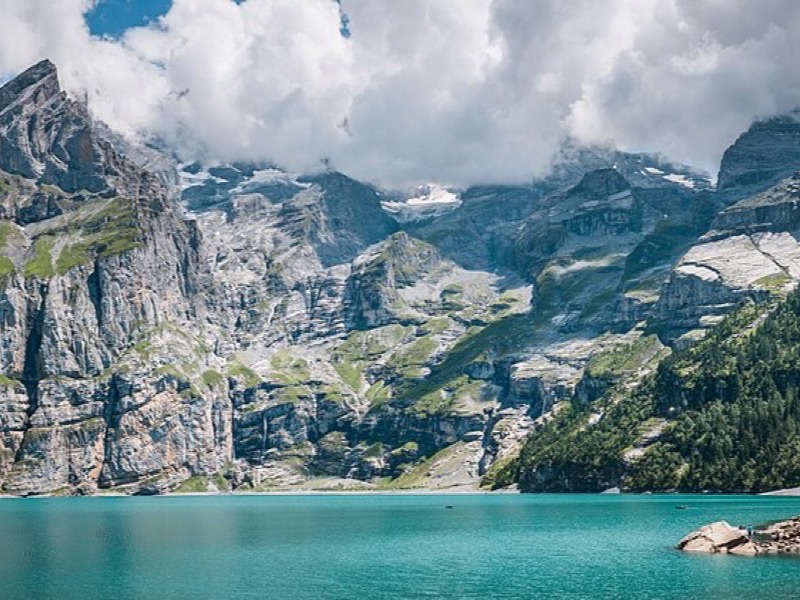
Switzerland has no sea coast, but it has more than 1,500 lakes, ranging from the 580-square-kilometre Lake Geneva to unnamed tarns above 2,000 metres. The towns covered on this page — Lucerne, Montreux and Vevey on Lake Geneva, Lugano on Lago di Lugano, Brienz and Interlaken on the Bernese Oberland lakes, Zug on Zugersee, and Ascona with Locarno on Lago Maggiore — each offer a different character of lakefront experience. All are reachable by public transport from Basel in under three hours. This guide focuses on the practical experience: steamer fares, swimming conditions, walking routes, when to go and what you can do on a single day versus what requires an overnight stay.
Lucerne: Gateway to Central Switzerland
Lucerne (Luzern) is Switzerland's most-visited city after Zurich and Geneva, and the editorial desk considers the first-time visitor's assumption that it will be over-touristy to be only partially correct. The Chapel Bridge (Kapellbrücke), the medieval covered wooden footbridge with its interior triangle paintings, is genuinely remarkable; the Water Tower alongside it and the preserved section of the city wall above Museggstrasse place the old town in a comprehensible historical context. The Lion Monument (Löwendenkmal) in the Glacier Garden, commemorating Swiss Guards who died defending Louis XVI in 1792, takes roughly 20 minutes of your time and should not be skipped on account of its tourist reputation.
The real reason to include Lucerne in an itinerary of a week or more is its position as the hub of Lake Lucerne (Vierwaldstättersee), one of Switzerland's largest and most irregularly shaped lakes. The SGV paddle steamer network from Lucerne pier connects to Vitznau (starting point of the Rigi rack railway), Weggis, Beckenried, Brunnen and Flüelen — the latter the embarkation point for the Gotthard Panorama Express train described in our panoramic trains guide. All steamers are included in the Swiss Travel Pass at no extra cost. A return trip to Rütli (the meadow where the Swiss Confederation was traditionally said to have been founded in 1291) costs CHF 52 per adult without a pass; the Rütli steamer stop is included in most day cruises and takes around 75 minutes from Lucerne in each direction.
The Lucerne lakefront promenade runs for several kilometres between the main pier and the Tribschen museum quarter, with public swimming allowed at the Lido from June through September (entrance CHF 8 per adult, open 09:00–19:00 daily in season). The water temperature in July and August averages 20–22 degrees Celsius. If visiting in May or early June, bring a wetsuit or accept that the water is invigorating at 15–17 degrees. Bicycles can be rented at Lucerne station from CHF 27 per day and the lakefront cycle path toward Horw and Küssnacht is flat and well-maintained.
Montreux and Vevey: The Lake Geneva Riviera
Montreux occupies a sheltered bay at the eastern end of Lake Geneva (Lac Léman) and is the warmest of Switzerland's major towns by average annual temperature, which is why palm trees grow on its lakefront promenade. The Château de Chillon, the best-preserved medieval castle in Switzerland, sits on a lake rock 3 kilometres south of Montreux and is accessible by foot along the waterfront promenade in 40 minutes, or by a short bus journey. Entrance costs CHF 14.50 for adults; the castle's history as a Savoyard fortress, Bernese administrative post and Romantic literary inspiration (Lord Byron wrote The Prisoner of Chillon in 1816 after visiting) is presented in English throughout. Audio guides cost an additional CHF 5.
The Lavaux vineyard terraces between Montreux and Lausanne — a UNESCO World Heritage Site since 2007 — are directly accessible by train from Montreux in 10–20 minutes to villages including Épesses, Cully or Saint-Saphorin. The walking trail through the terraces is marked and well-maintained; dogs are allowed on leads. The wine produced here (primarily Chasselas) can be tasted at cooperative cellars in most villages; the Commune de Rivaz offers tasting by the glass from CHF 4. The trail is most rewarding in September and October when the harvest is underway and the vines turn amber.
Vevey, 7 kilometres west of Montreux and reachable by train in 6 minutes, is less crowded and has a broader lakefront food market on Tuesday and Saturday mornings (Grand-Place, 07:30–12:30, free entry). Vevey is the headquarters of Nestlé and the Alimentarium food museum here (CHF 13 adult, Tuesday–Sunday) is a more thoughtful museum than its corporate sponsorship might suggest, covering 10,000 years of food history in Central Europe. Lake Geneva paddle steamer cruises operate from both Montreux and Vevey; a full lake crossing to Évian-les-Bains in France takes about 35 minutes (CHF 25 return; Swiss Travel Pass not valid on the French side). The CGN (Compagnie Générale de Navigation) offers half-day and full-day cruises from CHF 36 per adult; Swiss Travel Pass covers all Swiss lake cruises on Lake Geneva.
Lugano: Ticino's Lakeside Capital
Lugano is the largest city in Canton Ticino and the financial centre of Italian-speaking Switzerland. It sits on the north shore of Lago di Lugano at 273 metres, significantly lower and warmer than the alpine resorts, which is why the vegetation — oleander, cypress, bougainvillea — feels Mediterranean rather than alpine. The city is reached from Zurich by IC train in 2 hours 45 minutes via the Gotthard Base Tunnel, or by the slower panoramic route (Gotthard Panorama Express) in a full day.
The lakefront at Lugano — the Lungolago — is a 3-kilometre promenade of plane trees, park benches and open-air cafes between the Paradiso pier to the south and the Parco Civico to the north. The Parco Civico is the largest urban park in Ticino and contains the Cantonal Art Museum (Museo Cantonale d'Arte), which houses a permanent collection of Ticinese and Italian painting from the 19th century onwards (CHF 10 adult, Tuesday–Sunday). The Lugano Lido on the lakefront charges CHF 8 per adult for access to the pool and lake swimming area; water temperatures in July and August reach 24–25 degrees Celsius, the warmest in Switzerland.
Monte San Salvatore (912 m), reachable by funicular from Paradiso station, and Monte Brè (925 m), reachable by funicular from Cassarate, both give ridge-top views over the lake and the Ticino pre-Alps; each funicular takes 12 minutes and costs approximately CHF 22 return. Half Fare Card gives 50 percent off both. Monte San Salvatore has a terrace restaurant and a small geological exhibition; Monte Brè has the village of Brè with traditional stone houses and a hiking trail network. Both summits are accessible from May to October; the Monte San Salvatore funicular closes in November for maintenance.
Day trips from Lugano reach Gandria (a car-free fishing village 5 km east, accessible by boat or a 90-minute lakeside walking path), Morcote (voted the most beautiful village in Switzerland by popular vote, 12 km south by boat, 30 minutes, included in Swiss Travel Pass), and Ceresio peninsula villages reachable by PostBus. Morcote's arcaded waterfront, 14th-century church on the hill and vine-covered hillside represent the most photogenic lakeside composition in Ticino.
Brienz and Interlaken: The Bernese Lakes
Interlaken occupies the narrow isthmus between Lake Thun (Thunersee) to the west and Lake Brienz (Brienzersee) to the east, making it the only Swiss town with two lakes of different characters immediately accessible from its main street. The Höheweg promenade, lined with large hotels that have served British and German travellers since the 1860s, still functions as the town's social spine; the Jungfrau peaks visible at the far end of the valley frame a view that has not changed since the first panoramic lithographs were printed here in 1830.
Lake Brienz is the less-visited and more visually striking of the two, with turquoise water that contrasts sharply with the dark forested cliffs that rise directly from its northern shore. The lakeside road to Giessbach — a waterfall accessible by funicular from the lake pier, free to enter on foot, CHF 5 for the funicular — is an easy half-day from Interlaken. The historic Grand Hotel Giessbach (1873) above the falls accepts non-resident guests for lunch and its terrace overlooking the waterfall and lake is one of the more dramatic restaurant settings in Switzerland. The Brienzer Rothorn rack steam railway, departing from Brienz station (22 minutes east of Interlaken Ost by train), climbs to 2,350 metres above the lake on one of the last regular steam rack railways in Europe. Return from Brienz is CHF 78; Swiss Travel Pass gives 50 percent off to CHF 39.
Lake Thun, to the west, has a more gentle character — broader, flatter shores, the medieval town of Thun at its western end (with its castle, the Schloss Thun, free on foot around the exterior; CHF 12 for the interior), and the Stockhorn mountain (2,190 m) visible from the lake. The steamer from Interlaken West to Thun takes 1 hour 45 minutes and stops at Spiez — a small town above the lake with one of Switzerland's best-preserved medieval castles on a vine-covered promontory (CHF 10 adult, April–October). All Lake Thun and Lake Brienz steamers are included in the Swiss Travel Pass.
Zug: The Overlooked Lake Town
Zug (Zugersee) is a canton and city that most Swiss travel guides mention briefly as a financial hub and skip over as a lakeside destination. This is understandable in terms of celebrity but unreasonable in terms of quality. The old town of Zug, compact and well-preserved with a clock tower (Zytturm), painted facades on the market lane, and a lakefront promenade directly below the historic centre, offers most of what Lucerne offers at a fraction of the visitor density. The Zugersee is small enough (38 square kilometres) that the opposite shore is always visible; on clear days the Rigi and Pilatus are reflected in the water.
Zug is 24 minutes from Zurich by IC train and 45 minutes from Lucerne. Steamer cruises on the Zugersee operate from May to October; a full lake circuit takes approximately 2 hours 30 minutes and costs CHF 18 for adults. The Swiss Travel Pass covers Zugersee steamers. Fishing boats still operate from the wooden pier at Zug old town; the Kirschwasser (kirsch) produced in Zug canton is reputedly the finest in Switzerland and available from specialty food shops near the Kolinplatz market square for CHF 28–45 per 20cl bottle.
Ascona and Locarno: Lago Maggiore
Ascona and Locarno are on the Swiss section of Lago Maggiore in Canton Ticino, about 45 minutes south of Bellinzona (itself directly on the Lugano–Zurich rail axis). Locarno is a small city of 16,000; Ascona, 4 kilometres west along the lake shore, is a resort village and the most southerly town in Switzerland. Both are reached by train from Lugano (direction Domodossola or Locarno) in approximately 55 minutes, or from Zurich with a change at Bellinzona in around 2 hours 45 minutes.
The piazza in Ascona — Piazza Motta — runs directly to the water's edge and is one of the pleasantest public spaces in Switzerland, shaded by plane trees and faced by coloured houses of the 16th–18th centuries. The Lago Maggiore promenade from Ascona to Locarno takes 55 minutes on foot along the shore. Lake swimming from public beaches (Lido di Locarno and Lido di Ascona) is the primary summer activity; water temperatures reach 26 degrees Celsius in August, the warmest in Switzerland. Lido entrance is CHF 7 per adult. The Delta campsite at Locarno, which doubles as a public beach and park, charges CHF 5 per adult for day use of the beach.
Locarno is best known internationally for the Locarno Film Festival (August), which projects films on the Piazza Grande, the largest open-air cinema screen in the world at 8,000 square metres. Festival tickets for Piazza Grande screenings cost CHF 36–48; advance booking opens in June at locarnofestival.ch. For visitors arriving outside the festival period, the Cardada cable car from Locarno rises to 1,340 metres above the lake in 9 minutes (return CHF 34 adult; Half Fare Card 50% off) and gives a panorama over the Swiss and Italian sections of the lake.
Lakeside Towns: Key Facts
| Town / Lake | Travel time from Basel | Steamer pass-valid | Swimming temp (Aug) | Best period |
|---|---|---|---|---|
| Lucerne / Vierwaldstättersee | 55 min (IC direct) | Yes (SGV, full coverage) | 20–22 °C | June–September |
| Montreux / Lac Léman | 2 h (IC via Bern) | Yes (CGN Swiss section) | 21–23 °C | May–October |
| Lugano / Lago di Lugano | 3 h 15 min (via Gotthard) | Yes (SNL) | 24–25 °C | May–October |
| Brienz / Brienzersee | 2 h 15 min (via Bern, Interlaken) | Yes (BLS Schifffahrt) | 19–21 °C | June–September |
| Thun / Thunersee | 1 h 45 min (IC via Bern) | Yes (BLS Schifffahrt) | 20–22 °C | June–September |
| Zug / Zugersee | 1 h 20 min (via Zurich) | Yes (Zugersee Schifffahrt) | 21–23 °C | June–September |
| Locarno & Ascona / Lago Maggiore (CH) | 3 h 45 min (via Bellinzona) | Yes (NLM, Swiss section) | 24–26 °C | May–October |
When to Go and What to Expect Seasonally
Swiss lake towns show more seasonal variation than alpine resorts in one specific way: the restaurants, steamers and lakefront services operate seasonally, and arriving in November or March means finding boarded-up kiosks and reduced steamer frequency. For the full lakeside experience — open water swimming, full steamer timetables, lakefront food stalls and evening promenade life — plan visits between late May and the end of September.
July and August are the peak months, with corresponding crowds at Lucerne Chapel Bridge, Montreux lakefront and Lugano Piazza della Riforma. The editorial desk's consistent recommendation for those seeking the lakeside atmosphere without the high-season density is early June or September. In early June, the air is warm enough for lake swimming (especially in Ticino) and hotel prices are 15–25 percent lower than in August. September retains full steamer services and harvest activity in the vineyard regions near Montreux and Lugano adds an extra layer of interest.
Rain is a feature of Swiss lake weather from April through July; Lugano and Locarno receive more rainfall than anywhere else in Switzerland (up to 1,900 mm per year) despite also being the warmest and most southerly. This means that the Ticino lakes are best experienced during stable high-pressure periods rather than booked on the assumption of guaranteed sunshine. Check forecasts 48–72 hours in advance and have an indoor option — a museum, the Lugano casino, or the Locarno old town covered arcades — as backup.
For combination trips from the lake towns toward alpine terrain, the glacier viewpoints at Jungfraujoch and Titlis are accessible as day trips from Lucerne and Interlaken respectively; see the glacier viewpoints guide for timing and ticket details. The historic quarters guide covers the old towns of Lucerne, Fribourg and Murten, all of which have direct rail connections to Lake Geneva and the Bernese Oberland lakes.