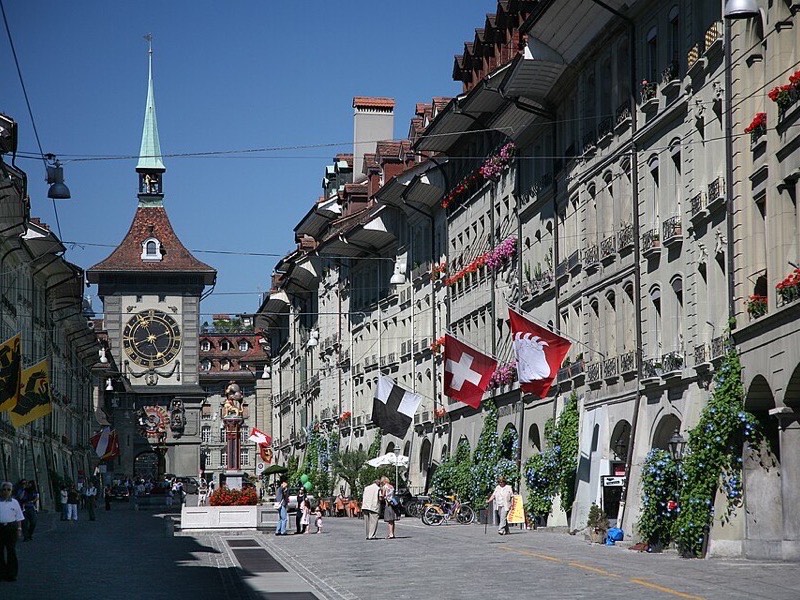
Switzerland has a higher density of intact medieval and early modern town centres than most visitors expect. The Confederation's political fragmentation into cantons and its geographical position as a crossroads between Germanic, Romansh, French and Italian cultures produced an unusual variety of urban forms: the sandstone arcade city of Bern, the Rhine frontier towns of Stein am Rhein and Schaffhausen, the Gothic river-bend city of Fribourg, the lakeside Roman foundation of Basel, the Burgundian walled town of Murten. None of these is a theme-park reconstruction; all are lived-in administrative centres with working shops, restaurants and residents. This guide covers each in sufficient detail to plan a single day, giving practical walking routes, costs of paid sights and the editorial desk's view on what justifies the entrance fee.
Bern Altstadt: The Arcaded Capital
Bern is the federal capital of Switzerland and its Altstadt (Old City) is a UNESCO World Heritage Site, inscribed in 1983. The inscription covers the medieval street plan that has survived without significant alteration since the 12th century, the 6 kilometres of arcaded walkways (Lauben) running under the first floors of buildings along the main commercial streets, and the overall urban composition formed by the Aare river's tight horseshoe bend around the peninsula. The city was founded by Duke Berchtold V of Zähringen in 1191, and the grid of streets — Kramgasse, Gerechtigkeitsgasse, Marktgasse, Spitalgasse — follows the original medieval plan.
The Zytglogge (Clock Tower) at the junction of Kramgasse and Marktgasse is the most elaborate medieval clock mechanism in Switzerland. The animated figures — a jester, a procession of bears, a knight and an onion dome crow — perform four minutes before each hour, triggered by the astronomical clock. The performance begins at 3 minutes and 59 seconds before the hour; arrive in good time. The tower mechanism is accessible by guided tour, which departs daily at 14:30 from May through October (CHF 20 per adult; book at the Bern tourism office or online). The tour takes 50 minutes and the guide explains both the mechanics and the history of the tower, which has been the time standard for Basel on the western end and for the entire Swiss plateau since the medieval period.
The Rose Garden (Rosengarten) above the Nydegg bridge on the eastern edge of the peninsula offers the best elevated view of the Aare bend and the Altstadt roofline. It is free, accessible by a 10-minute walk from the Bärenpark bear enclosure at the end of Gerechtigkeitsgasse. The Bundeshaus (Federal Palace), the parliament building at the western end of the peninsula, can be visited on free guided tours on Mondays and Saturdays during non-session weeks (book at bern.ch/bundeshaus). The interior hall with its 63-metre dome and cantonal coats of arms is one of the more impressive public rooms in the country and admission is genuinely free.
The arcades provide full shelter from rain, which is why Bern is often cited as one of the better Swiss cities to visit in unpredictable weather. The 6 kilometres of Lauben are continuous and connect all the main shopping streets; even a heavy downpour does not require an umbrella between the Federal Palace and the Nydegg bridge. The underground arcades contain a mixture of high-street shops, independent bookshops, watchmakers and small restaurants; the quality of the food at basement-level traditional restaurants (Kornhauskeller in the 18th-century granary vault, Klötzlikeller wine cellar on Gerechtigkeitsgasse) is above what the tourist location might suggest.
Lucerne: Chapel Bridge and the Old Town
Lucerne's historic centre is compact and well-mapped, making it possible to cover the main sights in a morning and combine it with a lake steamer in the afternoon. The Chapel Bridge (Kapellbrücke) is the most-photographed object in Switzerland — a 14th-century covered wooden footbridge crossing the Reuss river diagonally, with a hexagonal Water Tower at its midpoint that has served as treasury, archive and torture chamber at various points in its history. The bridge was partly destroyed by fire in 1993 and subsequently rebuilt; the 17th-century triangle paintings in the roof beams were largely destroyed in the fire, but the surviving originals were restored and some sections of replacement panels are now visible where the originals were lost. This history is documented in the adjacent museum without charge.
The Museggmauer city wall on the northern edge of the old town predates the Chapel Bridge and offers one of the most accessible free walking experiences in Switzerland. Nine towers remain standing along the 870-metre preserved wall section; three are open to the public from April through October (Zytturm, Männliturm and Luegisland), providing elevated views over the old town and the lake. No booking, no fee, no guide required. The Zytturm is the only tower in Switzerland still empowered by civic charter to set its clock 1 minute ahead of all other clocks in the city — an old market right that persists, more or less, to the present day.
The Weinmarkt and Hirschenplatz squares in the centre of the old town are functioning urban spaces rather than tourist stages, with weekly farmers' markets (Saturday morning, 07:00–12:00, free). The street-level restaurants around these squares vary considerably in quality and price; the editorial desk recommends Wirtschaft Galliker on Schützenstrasse (traditional Central Swiss cooking, CHF 25–40 per main) and Brasserie Bodu on Kornmarkt (Alsatian-influenced menu, CHF 30–45) as reliable options within 8 minutes' walk of the old town centre. The Rosengart Collection (Picasso and Paul Klee), housed in the former National Bank building at Pilatusstrasse 10, is the strongest art museum in the city (CHF 18 adult, daily 10:00–18:00 in summer).
Stein am Rhein: Painted Facades on the Rhine
Stein am Rhein is a small town of approximately 3,200 residents on the Rhine where it exits Lake Constance (Bodensee) in Canton Schaffhausen. It is the most concentrated example of secular mural painting in the German-speaking world: the facades of the half-timbered houses on and around the Rathausplatz (town hall square) are painted floor-to-eave with historical narratives, heraldic devices, allegorical figures and town chronicles. The paintings date primarily from the 16th and 17th centuries, with subsequent restoration; the most elaborate are on the Weisser Adler (White Eagle), the Sonne and the Roter Ochsen (Red Ox) inn facades. The work is remarkably well-preserved for outdoor mural painting of this age, in part because the deep overhanging eaves of the half-timbered construction have sheltered the wall surfaces from direct rain for centuries.
The Kloster St. Georgen (St. George's Monastery), directly on the Rathausplatz, is the only Benedictine monastery in the German-speaking world to have survived the Reformation with its medieval fabric intact. The cloisters and the abbot's hall with its late-Gothic wall paintings are accessible via a small museum (CHF 5 adult, Tuesday–Sunday, 10:00–17:00 from March through October). The Hohenklingen castle above the town (free exterior, CHF 4 for the tower, closed in winter) provides the best elevated view of the Rhine, the old town and Lake Constance in the distance.
Getting to Stein am Rhein from Basel takes approximately 70–80 minutes by train with a change at Schaffhausen (SBB + Thurbo regional train, full covered by Swiss Travel Pass). The Rhine waterfall at Schaffhausen (Rheinfall), 10 kilometres west of Stein am Rhein, is a natural complement to the old town visit; it is the largest waterfall in Europe by water volume, with a crest of 150 metres and a drop of 23 metres. Access to the rocks in the river at the waterfall's centre costs CHF 5 from the Schloss Laufen viewpoint. A half-day combining Schaffhausen city (its own well-preserved old town with the Munot fortress), the Rheinfall and Stein am Rhein is a standard editorial desk recommendation for day trips from Zurich or Basel.
Basel Old Town: Two Banks of the Rhine
Basel is the editorial desk's home city and the one most likely to be underestimated by visitors who associate it primarily with Art Basel (the contemporary art fair) or the pharmaceutical industry. The old town spans both banks of the Rhine and is distinct in character on each side: Grossbasel on the elevated left bank holds the cathedral hill (Münsterhügel), the medieval market squares and the main shopping streets; Kleinbasel on the lower right bank has a more working-class, multi-ethnic and currently rapidly gentrifying character with the best concentration of small independent restaurants in the city.
The Basler Münster (Basel Cathedral) is the most significant building in the old town — a Romanesque and Gothic structure begun in 1019, rebuilt after the 1356 earthquake, and substantially completed by 1500. The exterior red sandstone carving, particularly the Galluspforte (St. Gallus portal) on the north side, is among the finest Romanesque sculptural work in the region. The interior is free to enter (Monday–Saturday 10:00–17:00, Sunday from 11:30); the cloister is free and contains the tomb of Erasmus of Rotterdam. The north tower is open to climb for CHF 5, with views over the Rhine bend and the Alsace plain. The adjacent Münsterplatz is large, flat and shaded by lime trees; the Tuesday and Saturday morning market here (07:00–13:00) sells regional food, cut flowers and second-hand books.
The Old Town of Basel is walkable in 90 minutes at a comfortable pace covering the Münster, the Barfüsserplatz (main square, Historisches Museum Basel in the Gothic Barfüsserkirche, CHF 12 adult), the Marktplatz with its painted Renaissance Rathaus (city hall facade, free to view from outside, inner courtyard free to enter), and the riverside Rheinweg promenade, where locals swim in the Rhine current from June through August using dry bags to transport their belongings. The riverside swimming tradition is not a tourist activity; it is a local habit, and the water is clean enough for it from June, with most participants swimming a kilometre or more downstream with the 4–5 km/h current before emerging at Kleinbasel. Visitors are welcome to join; wear a swimsuit that can withstand current, and rent a "wickelfisch" dry bag from several shops near the river for CHF 30–40 (also available for purchase at the Coop near Marktplatz).
Fribourg: Gothic River City on the Linguistic Border
Fribourg (Freiburg) sits in Canton Fribourg at the exact linguistic border between French-speaking and German-speaking Switzerland; in the old town, street names appear in both languages on the same signs, and the majority population shifts from German in the upper town (Haute-Ville) to French in the lower sectors. The city is built on a rock peninsula above a tight bend in the Sarine (Saane) river, with the lower town (Basse-Ville) visible 50 metres below through the medieval streets. The scale of this topographic drama — standing on the Berne Gate bridge and looking down the cliff at the lower town and the river below — is unexpected for a city of 40,000 people.
The Cathédrale Saint-Nicolas de Myre is the most visited building in Fribourg and one of the most important Gothic interiors in Switzerland. Construction began in 1283 and the nave was completed around 1430; the choir screen and pulpit are 15th-century work. The 1896 stained glass windows in the Chapel of the Holy Sepulchre, designed by the Polish artist Josef Mehoffer, are considered among the finest Art Nouveau church windows in Europe. Entry to the cathedral is free; climbing the tower (76 metres, 368 steps) costs CHF 3 and provides an unobstructed view over the Sarine valley and the pre-Alps to the south. The tower is open Monday–Saturday 10:00–12:00 and 14:00–17:00, Sundays from 14:00, from April through October.
The Fribourg funicular (Standseilbahn Fribourg) connects the upper and lower town in a 4-minute descent of 50 metres. It is one of the few funiculars in the world that was historically powered by the weight of wastewater collected in a tank beneath the upper car, which was filled from the city cisterns and emptied at the bottom. The system was converted to electric operation in 1966, but a placard in the lower station explains the original hydraulic mechanism. The funicular costs CHF 1.70 per journey (single, cash or contactless); the Swiss Travel Pass does not cover it. The lower town, once reached, has the most intact collection of medieval craftsmen's houses in Fribourg, particularly on Rue de la Samaritaine and Rue d'Or, which run along the base of the cliff below the cathedral.
Murten: The Intact Burgundian Town
Murten (Morat in French) is a small walled town of about 7,000 people on the eastern shore of Lake Murten (Murtensee) in the bilingual part of Canton Fribourg. It was founded by the Dukes of Zähringen in the 12th century and was the site of the 1476 Battle of Murten, in which the Swiss Confederation defeated the Burgundian army of Charles the Bold, a victory that confirmed Swiss military independence from Burgundian domination and is still commemorated by a gun salute on the Sunday nearest to 22 June. The town walls are complete and form a walkable rampart path of approximately 1.2 kilometres (free, open year-round; some sections limited to April–October).
Murten is a working market town, not a museum piece. The main street (Hauptgasse) is arcaded in the local Fribourg style, with shops and restaurants at ground level and residential upper floors. The weekly Saturday morning market on the Rathausgasse (07:00–12:00) sells local Fribourg produce including Gruyère cheese from the nearby Gruyères valley (available from CHF 4 per 100g at the market), regional sausages, honey and produce from small farms on the Murten plain. The Historisches Museum Murten in the castle (CHF 6 adult, Tuesday–Sunday) covers the Battle of Murten in detail and is compact enough to visit in 45 minutes.
Lake Murten is small (23 square kilometres) and calm, used primarily for sailing and kayaking. A steamer service operates from June through September from the Murten pier, connecting to Môtier and the Roman town of Avenches (5 kilometres inland; free archaeological site, the Roman amphitheatre is the largest in Switzerland, free to enter). Swiss Travel Pass is valid on the Murtensee steamer. The editorial desk recommends Murten as a full-day base for visitors staying in Fribourg or Bern: take the steamer to Avenches in the morning, return by PostBus, and spend the afternoon on the town walls and in the lake. Murten is 18 minutes from Fribourg by train and 28 minutes from Bern.
Free vs Paid Sights at a Glance
| Town | Free highlights | Paid highlights | Price (adult) |
|---|---|---|---|
| Bern | Zytglogge exterior, arcades, Rose Garden, Bundeshaus (free tour) | Zytglogge tower tour; Bern Hist. Museum; Einstein House | CHF 20 / CHF 13 / CHF 10 |
| Lucerne | Chapel Bridge, Museggmauer wall & 3 towers, Weinmarkt | Glacier Garden; Rosengart Collection | CHF 14 / CHF 18 |
| Stein am Rhein | Rathausplatz facade walk, Rhine promenade | Kloster St. Georgen; Hohenklingen tower | CHF 5 / CHF 4 |
| Basel | Münster interior & cloisters, Marktplatz Rathaus courtyard, Rheinweg | Münster north tower; Historisches Museum | CHF 5 / CHF 12 |
| Fribourg | Cathédrale Saint-Nicolas interior, lower town streets, funicular (CHF 1.70) | Cathedral tower; Musée d'Art et d'Histoire | CHF 3 / CHF 10 |
| Murten | Complete town wall circuit, Hauptgasse arcades, Saturday market | Historisches Museum Murten; Avenches Roman site (free) | CHF 6 / free |
Walking Route Outlines
Each historic quarter is navigable without a guide. The following outline routes are designed as self-guided walks taking 2.5 to 3.5 hours each, covering the main sights on foot in a logical sequence without backtracking.
Bern: Start at the main station (Bahnhof Bern), walk east along Spitalgasse under the arcades to the Zytglogge. Continue east on Kramgasse (note the Einstein House at number 49) to Nydegg bridge. Cross to the Bärenpark. Return along the south bank (Untertorgasse, Junkerngasse) to the Münster platform and Rose Garden. Descend by the external staircase to the lower town and the covered market arcade (Kornhaus). End at the Bundeshaus terrace. Total approximately 4 kilometres, no significant climbing.
Lucerne: Start at the main station. Cross the Chapel Bridge westward. Walk north through the old town streets to the Weinmarkt. Continue to the Museggmauer wall at the northern edge; enter the Zytturm tower. Walk the wall section east to the Männliturm and Luegisland towers. Descend to the Reuss river at the Spreuerbrücke (the second covered bridge, with its Dance of Death paintings, free to enter). Return to the main station along the south bank. Total approximately 3 kilometres.
Fribourg: Start at the main station, take the free city bus to the Cathédrale stop. Enter and explore the cathedral. Walk east to the cliff viewpoint above the Sarine river. Descend by the funicular (CHF 1.70) or the covered wooden staircase (free) to the lower town. Walk the lower town streets (Rue de la Samaritaine, Grand-Fontaine quarter). Ascend via the Berne Gate (Porte de Berne) to the upper town. End at the Ratzé quarter near the university. Total approximately 3.5 kilometres with significant elevation change.
Frequently Asked Questions
Most of the historic towns covered here are also convenient bases for day trips to alpine terrain. Bern and Fribourg provide quick access to the Bernese Oberland glaciers described in our glacier viewpoints guide. Lucerne is the most natural base for combining an old-town visit with a lake steamer and a rack railway excursion — both activities are covered in depth in the lakeside towns guide and the panoramic trains guide.