Skip to content
Red cogwheel mountain train climbing above the treeline in the Swiss Alps
Independent desk reviews

All Reviews

Twelve Swiss experiences evaluated by the Basel desk — panoramic railways, high-altitude viewpoints, glacier walks, steamer crossings, and the old towns that hold everything together.

Switzerland compresses more spectacular scenery per square kilometre than anywhere else in the Alps. But the country also compresses its options: the right choice of pass, the right departure time, the right combination of train and boat can transform a standard holiday into something you will spend years describing to other people. The wrong combination produces an expensive series of queues. This catalogue exists to help you tell the difference.

Everything reviewed here was assessed by the Alpenroute Editorial desk in Basel without press passes, familiarisation rates, or commercial arrangements with railway operators. Prices quoted are standard adult second-class fares or adult entry prices in Swiss francs (CHF) at the time of writing; they are updated each season. For bespoke route planning built around your specific dates and budget, see our travel-planning tiers or write to the desk directly.

Panoramic railways

The long-distance scenic trains

Switzerland's panoramic train network is the most developed in the world. Four routes hold UNESCO World Heritage status, and the engineering behind them — rack systems, spiral tunnels, viaducts cantilevered over gorges — is worth understanding before you board. The reviews below cover the routes the desk considers genuinely worth the fare premium over ordinary InterCity services. For a deeper look at the full network, visit our panoramic trains guide.

Glacier Express — Zermatt to St. Moritz

The Glacier Express is the most famous slow train in the world, and that epithet — "slow" — is genuinely accurate. At 291 kilometres over eight hours, it averages 36 km/h, which gives passengers the opportunity to watch the Rhone Valley flatten, narrow, and then fold itself into the Oberalppass at 2,033 metres before descending into the Engadine. The route passes through 91 tunnels and across 291 bridges, a figure that once seemed like marketing copy until you actually count the viaducts south of Chur.

Matterhorn Gotthard Bahn and Rhaetian Railway operate the service jointly, running year-round except for a brief maintenance window in November. The panoramic windows are triple-glazed and tilt inward slightly to reduce glare — a detail that matters enormously on a sunny summer morning when the Aletsch region is to your south. The Excellence Class dining car, introduced in 2022, offers a four-course menu sourced almost entirely from cantons the train passes through; the Valais lamb and St. Gallen bratwurst courses are particular high points. Second class with a seat reservation is sufficient for the views; Excellence Class is a separate experience closer to a restaurant with scenery attached. Reserve seats a minimum of eight weeks in advance for July and August travel.

The desk recommendation is to travel westbound (St. Moritz to Zermatt) in the morning so that the descent to the Matterhorn arrives in afternoon light. The reverse direction puts the Engadine sunrise behind you and the Valais in late-afternoon gold.

Bernina Express — Chur to Tirano (Italy)

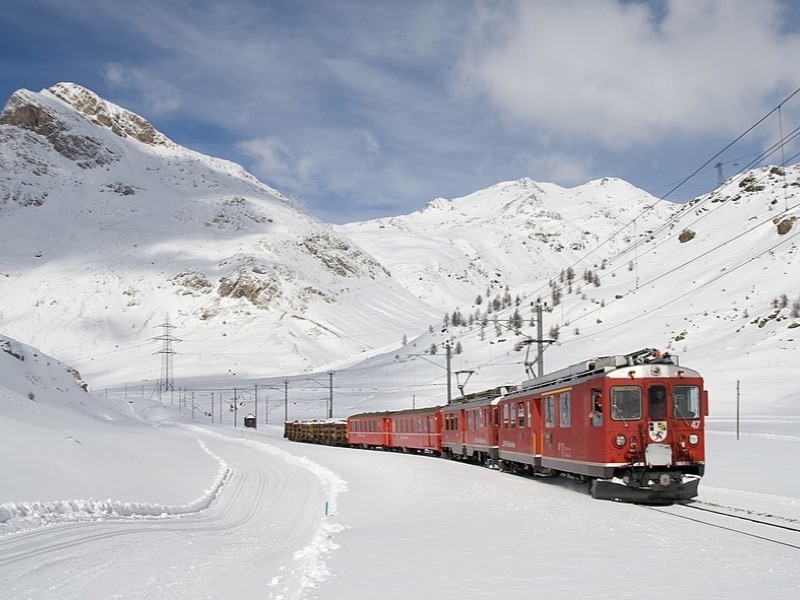
The Bernina Express crosses the highest altitude main railway line in the Alps without a single rack segment — pure adhesion, entirely above 2,000 metres for a significant portion of the journey. The Bernina Pass summit at 2,253 metres sits above the permanent snowline for most of the year, which means that even in June the train runs between walls of compressed ice and past the Morteratsch Glacier tongue. This is the route the desk considers the single best value for dramatic scenery per franc spent in Switzerland.

The route descends from the Alpine watershed into the Poschiavo valley and then continues into Valtellina in northern Italy, terminating at Tirano. The cultural shift between the Engadine (stone houses, Romansh lettering, Reformed churches) and the Lombard foothills (terracotta tile, Italian signage, palm trees) happens in under two hours of travel and without a border formality beyond a brief passport check at Campocologno. Rhaetian Railway operate the service; the panoramic coaches use the same fleet as the Glacier Express. A combined Chur–Tirano–Lugano itinerary connecting via PostBus over the Maloja Pass makes for a logical two-day Alpine traverse. Full context on this route is available in our panoramic trains guide.

GoldenPass Line — Montreux to Interlaken to Lucerne

The GoldenPass connects Lake Geneva to Lake Lucerne across three distinct railway gauges, which until 2022 required passengers to change trains at Zweisimmen and Interlaken. The completion of the GoldenPass Express with gauge-changing bogies at Zweisimmen now allows through-running panoramic cars from Montreux to Interlaken Ost, making this the most technically sophisticated passenger train currently in operation on the Swiss narrow-gauge network. The Montreux to Zweisimmen section runs through the Pays-d'Enhaut — French-speaking Alpine pastureland with wooden chalets, cheese cooperatives open to visitors, and the kind of unhurried landscape that makes the Glacier Express feel busy by comparison.

The section from Interlaken to Lucerne via Brienz and the Brienzer Rothorn is operated by Zentralbahn on standard gauge with separate panoramic equipment. Lucerne itself is the natural end-point: the covered wooden bridge, the lake promenade, and the access to Pilatus and Rigi make it a serious base for several days. For a review of the lakeside towns the GoldenPass serves, see our lakeside towns page.

Gornergrat Bahn — Zermatt to Gornergrat (3,089 m)

The Gornergrat Bahn is the highest open-air railway in the Alps, running entirely on a rack system from Zermatt (1,608 m) to the Gornergrat summit station at 3,089 metres. The journey takes 33 minutes and gains 1,481 metres of altitude, passing through four distinct vegetation zones: pine forest, alpine meadow, dwarf shrub heath, and finally bare glaciated moraine. The summit view encompasses the Monte Rosa massif — the second-highest peak in the Alps — and a direct sightline to the Matterhorn's east face at a distance of roughly four kilometres. Twenty-nine glaciers are visible from the Gorner Ridge on a clear day.

The desk advises the first departure (typically 07:00) in summer to avoid cloud build-up and the tour-group congestion that accumulates by 09:30. The Kulmhotel Gornergrat, in operation since 1897, serves a serviceable breakfast at altitude. Return ticket: CHF 93 adult second class. The full context for this and other high-altitude vantage points is in our glacier viewpoints guide.
High-altitude experiences

Jungfrau Region and the Aletsch Arena

The Jungfrau Region centres on three peaks — Eiger (3,967 m), Mönch (4,107 m), and Jungfrau (4,158 m) — and the infrastructure built around them over 125 years. The Aletsch Glacier, descending from the Jungfraujoch saddle, is the largest glacier in the Alps and a UNESCO World Heritage site. Both experiences reviewed here require significant advance planning during the summer peak; the desk includes specific timing advice for each. Additional coverage of this region appears in our glacier viewpoints guide and family day trips section.

Jungfraubahn — Kleine Scheidegg to Jungfraujoch (3,454 m)

The Jungfraubahn runs inside the Eiger — literally through a tunnel bored through the north face of the mountain — and emerges at the Jungfraujoch saddle, 3,454 metres above sea level. The saddle holds the highest railway station in Europe. Construction took 16 years (1896–1912) and used a workforce that endured avalanche, altitude sickness, and two major tunnel explosions. The engineering context is explained in detail at the visitor centre inside the mountain, which is better than most people expect given how much else competes for attention at the summit.

From the Jungfraujoch platform you look south across the Aletsch Glacier — 23 kilometres of ice descending toward the Rhone Valley, up to 900 metres thick at the firn basin. The Sphinx Observatory at the eastern end of the saddle has an outdoor terrace at 3,571 metres; in calm conditions it is the finest viewpoint in the Swiss Alps for sheer visual scale. The Eiger Glacier station stop during the ascent offers a brief platform walk across a moraine bowl that most passengers skip and should not. Good-weather rate: CHF 160 adult return from Grindelwald via Kleine Scheidegg. Book the first departure of the day; midday queues at Kleine Scheidegg are substantial in July and August.

Aletsch Arena — Riederalp, Bettmeralp, Fiescheralp

The Aletsch Arena is the collective name for the three car-free villages perched on the moraine ridge above the Great Aletsch Glacier's southern flank. Access is by gondola from the Rhone Valley floor: Mörel for Riederalp, Grengiols for Bettmeralp, Fiesch for Fiescheralp. All three villages prohibit private motor vehicles above the valley station, which creates an atmosphere entirely unlike the larger ski resorts. In summer the main attraction is the 23-kilometre glacier itself, viewed from the Moosfluh viewpoint (2,333 m) above Riederalp or from the Bettmerhorn (2,857 m) reached by cable car from Bettmeralp.

The Pro Natura Centre Aletsch at Villa Cassel near Riederalp documents the glacier's retreat since the Little Ice Age maximum of around 1860 and provides one of the more sobering scientific exhibits in Swiss tourism. The distance the glacier's terminus has receded — viewable from the overlook path above Brig — is quantified year by year; the numbers are significant. The desk recommends a minimum two-night stay to do the main ridge walk justice; the Riederalp to Bettmeralp path along the glacier rim takes approximately four hours at moderate pace and the elevation changes are manageable. Gondola return from valley: CHF 32–38 depending on village. For winter conditions in this area, see our winter resorts review.

Mountain railways

Cogwheel climbs worth the ticket

Pilatus Bahn — Alpnachstad to Pilatus Kulm (2,073 m)

The Pilatus Bahn holds the world record for the steepest cogwheel railway, reaching gradients of 480 per mille (48%) on its climb from Alpnachstad on Lake Lucerne to the summit plateau at Pilatus Kulm. The rack system is the Locher type, unique to this railway — a horizontal double rack with teeth on both sides, which prevents the train from jumping the track on the extreme gradients. The engineering is visible and striking; the Locher system is clearly distinct from the Abt and Riggenbach racks used on every other cogwheel railway in Switzerland.

The summit plateau sits above a frequently dramatic weather divide: Lucerne below can be grey and the top can be in clear sunshine. The reverse is equally common. A trip works best as the centrepiece of a Lucerne day combining the boat crossing from Lucerne to Alpnachstad on a historic paddle steamer, the cogwheel ascent, and the descent by cable car to Kriens (summer only — the rack railway does not operate in winter). The combined Golden Round Trip package covers all segments and is priced at CHF 72 to CHF 96 depending on season. Full Pilatus context is part of our lakeside towns guide.

Lake Lucerne paddle steamers — Central Switzerland

Lake Lucerne (Vierwaldstattersee) is served by a fleet of historic paddle steamers operated by Schifffahrtsgesellschaft des Vierwaldstattersees (SGV), of which the oldest — the DS Stadt Luzern, built in 1928 — remains in regular scheduled service. The fleet operates the most extensive scheduled lake-steamer network in Switzerland, connecting Lucerne with Fluelen at the southern end of the lake and with the jetties for Rigi, Pilatus, and Burgenstock. A standard day return Lucerne–Fluelen–Lucerne covers the full length of the lake and takes approximately seven hours including the southern terminus stop.

The steamers serve as scheduled public transport, meaning a Swiss Travel Pass or Half Fare Card is valid on board — there is no scenic supplement to purchase. The restaurant car on the longer vessels serves a standard Swiss brasserie menu; the Weisswurst and Rosti at the Lake Uri (southern) end of the lake are consistently competent. The historical significance of the lake to Swiss nationhood — Tell's Chapel at Sisikon, the Rutli meadow at Seelisberg where the Oath of Confederation was sworn in 1291 — is covered in detail by the on-board audio guide available in seven languages. The desk considers this the single best-value half-day in Central Switzerland for the fare paid.

Historic urban quarters

Old towns that hold their weight

Switzerland's preserved medieval quarters are not museum pieces. People live in them, work in them, and shop in them on Saturdays. This matters for the visitor because it means the cafes are aimed at residents rather than tourists, the prices are not inflated for footfall, and the streets are genuinely lively rather than ceremonially preserved. The full catalogue of urban walking is in our historic quarters guide.

Bern old town

Bern's Altstadt is the largest intact medieval city centre in Europe north of the Alps, a UNESCO World Heritage site since 1983. The defining feature is six kilometres of continuous arcaded walkways — the Lauben — running beneath the upper floors of the sandstone buildings along the main streets. The arcades were a municipal requirement from the city's 12th-century founding charter; they function as both weather protection and social equaliser, running through palace fronts and modest tenements without interruption. The Federal Parliament (Bundeshaus) sits at the western end of the main axis and is open for guided tours without charge on days Parliament is not in session; the interior is significantly more impressive than the exterior suggests.

The Rose Garden above the Nydeggbrücke provides the definitive elevated view of the medieval roofline. The covered market at the lower Bahnhofplatz runs Tuesday and Saturday mornings and represents one of the most complete examples of a functioning Swiss weekly market still operating within a historic urban centre. Entry to the old town is free; guided walking tours in English operate from the Bern Tourism office at CHF 22 per adult. See also our food and markets review for the Tuesday market in detail.

Lucerne old town

Lucerne's historic centre organises itself around the Reuss river and the two covered wooden bridges that cross it. The Kapellbrücke, built in 1333, is the oldest surviving wooden bridge in Europe; it was substantially rebuilt after a 1993 fire but remains structurally and visually intact. The interior triangular panels, painted with scenes from Swiss and Lucerne history, were replaced with reproductions after the fire — the originals had been deteriorating for two centuries before they burned. The Spreuerbrücke (1408), less visited but in better original condition, retains its 17th-century Dance of Death paintings, a continuous frieze of 67 panels executed between 1616 and 1637.

The old town's main appeal is walkability — the compact medieval street plan, the guild houses on Weinmarkt and Kornmarkt, the Lion Monument carved into natural rock on Denkmalstrasse. The Rosengart Collection two minutes from the Kapellbrücke holds a significant Picasso and Klee holding in a former bank building. Entry CHF 18 adult. For the broader lake context and day-trip options from Lucerne, see our lakeside towns guide.

Kunstmuseum Basel

The Kunstmuseum Basel is the oldest public art collection in the world still housed in purpose-built premises — the original museum building opened in 1661, and the collection predates it, having been acquired by the city from the Amerbach Cabinet in 1661. The permanent collection's strengths are the largest Holbein the Younger holding outside London, an exceptional early Netherlandish and German painting section, and a post-1945 collection that is one of the three or four most significant in continental Europe. The Schaulager facility in Münchenbuchsee holds the overflow and research collection, accessible by appointment.

The main building and the 2016 extension building opposite it are connected by an underground passage; visitors typically underestimate the time required and attempt the permanent collection in ninety minutes, which is not adequate. Entry CHF 26 adult, first Sunday of the month free. The museum cafe in the extension building is run at a standard befitting a serious institution. For context on the wider Basel arts scene, which includes Art Basel in June and the Beyeler Foundation in Riehen, write to the desk for a tailored Basel itinerary. The Montreux and Lavaux lakeside context for wine-country visits is covered in our lakeside towns guide.

Lakeside wine country

Montreux and the Lavaux terraces

The Lavaux vineyard terraces between Lausanne and Vevey descend in steps from the forested ridge above to the north shore of Lake Geneva, a UNESCO World Heritage landscape since 2007. The terraces were constructed by Cistercian monks from the 11th century onward; the current configuration of over 30 villages and 830 hectares under vine represents largely intact medieval land-use structure. The dominant varieties are Chasselas (producing a pale, mineral, low-acid white entirely unlike the international style of the same grape), Pinot Noir, and Gamaret.

Access is most naturally by train: the regular service from Lausanne to Vevey takes 22 minutes and stops at Cully, Epesses, Rivaz, and St-Saphorin — all of which have co-operative cellars open for tasting at the station or within a three-minute walk of the platform. The Lavaux Panoramic tourist train from Cully (CHF 16) offers an alternative perspective from the upper terrace road. Montreux itself is most compelling in January (jazz-adjacent festival season), May (Rose Festival), and July (Montreux Jazz Festival, with free outdoor stages along the lakeshore). The Chateau de Chillon six kilometres east of Montreux is among the best-preserved medieval lake fortresses in Europe; entry CHF 13.50 adult. For itineraries combining Lavaux wine visits with family activities, see our family day trips guide.

At a glance

Fares and durations — comparison table

Standard adult second-class fares and approximate travel times for the principal reviewed experiences. All prices in CHF. Prices valid at time of publication; check operator websites for current fares. Swiss Travel Pass and Half Fare Card validity noted where applicable.

Experience Route / Site Duration Fare (CHF) STP / HF
Glacier Express Zermatt – St. Moritz 8 h 153 + 33 res. Yes / Yes
Bernina Express Chur – Tirano 4 h 65 + 14 res. Yes / Yes
GoldenPass Express Montreux – Interlaken 3 h 15 min 55 + 12 res. Yes / Yes
Gornergrat Bahn Zermatt – Gornergrat 33 min 93 rtn Yes / 50%
Jungfraubahn Grindelwald – Jungfraujoch 2 h 10 min 160 rtn 25% / 25%
Pilatus Bahn (Golden Round Trip) Lucerne – Pilatus Kulm – Kriens Half day 72–96 Yes / 50%
Lake Lucerne Steamer Lucerne – Fluelen rtn 7 h Incl. in STP Yes / 50%
Aletsch Arena gondola Riederalp / Bettmeralp Half day min. 32–38 rtn Yes / 50%
Kunstmuseum Basel Permanent + Extension 3–4 h 26 No / No
Chateau de Chillon Near Montreux 2 h 13.50 No / 50%

STP = Swiss Travel Pass (full inclusion). HF = Half Fare Card (50% reduction unless otherwise noted). Reservation fees (res.) are mandatory on panoramic trains and are not covered by any pass. For guidance on which pass delivers the best value for your specific itinerary, see our route-planning tiers.

Regional breakdown

Where each experience sits geographically

Switzerland's reviewed experiences cluster into four travel regions. Understanding the geography before booking prevents the common error of combining experiences that require impractical backtracking.

Western Alps and Valais

Zermatt (Gornergrat Bahn, Glacier Express western terminus), Aletsch Arena (Riederalp, Bettmeralp), and the Bernese Oberland (Jungfraujoch, Grindelwald) are all accessible from Bern or Interlaken as a base. A logical seven-day itinerary covers Bern (old town, Federal Parliament), the Jungfraujoch, Zermatt with Gornergrat, and the Aletsch Arena on the return north. The GoldenPass connects this region westward to Montreux and Lavaux. Our glacier viewpoints guide provides the detailed routing.

Central Switzerland and Lucerne

Lucerne is the natural hub for Central Switzerland: the old town and bridges, Pilatus Bahn, Lake Lucerne steamers, and Rigi are all accessible within a single day-trip radius. The GoldenPass Line connects Lucerne to Interlaken and onward to Montreux, making a west-east corridor possible by rail alone. For family-oriented combinations using Lucerne as base, see our family day trips guide.

Graubunden and the Engadine

The Bernina Express and the Glacier Express's eastern section both operate in Graubunden (Rhaetian Railway territory). St. Moritz is the resort base; Chur is the administrative capital and main rail junction. The Engadine combines the highest railway scenery in Switzerland with the best-preserved Romansh language communities. Allow at least two full days in the region — treating it as a transit point between the Glacier Express's two ends misses most of what makes Graubunden distinctive.

Basel and the northwest

Basel holds the Kunstmuseum and is the desk's home city. It is also Switzerland's most underrated base for visitors: direct international rail connections from Paris (3 h), Frankfurt (50 min TGV via Basel Badischer Bahnhof), and Amsterdam (via Cologne) make it a natural arrival point. The city's Art Basel, the Beyeler Foundation in Riehen, and the Vitra Design Museum ten minutes across the German border provide cultural density comparable to any European capital, with significantly less visitor pressure. Contact the desk for a Basel-based itinerary that extends into the wider Swiss network.

Not sure which combination makes sense for your trip?

The desk builds route plans around your specific dates, travel style, and budget — not around a standard itinerary template. See the planning tiers or write to us directly.

Ask the Basel desk