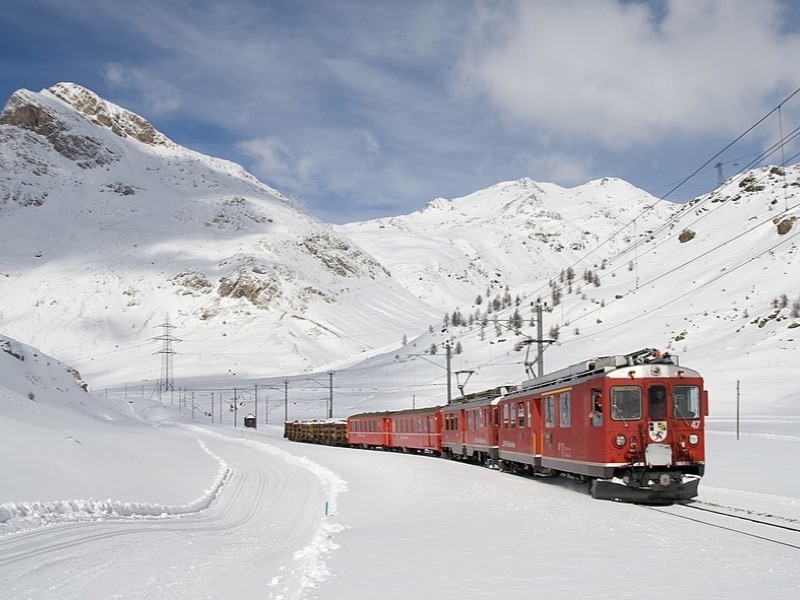
Switzerland operates more UNESCO-listed and engineering-landmark railways per square kilometre than any other country. These are not heritage novelties run on summer weekends; they are scheduled public transport connecting villages and cities across terrain that road engineers still consider extreme. The five routes covered on this page — Glacier Express, Bernina Express, GoldenPass Line, Gotthard Panorama Express, and the Jungfrau-region rack railways — together cover roughly 900 kilometres and climb through alpine passes, descend into palm-tree valleys and cross viaducts that appear in structural engineering textbooks. This guide gives you the practical information to ride them without overpaying, without missing the best seats, and without arriving at the station confused about what your pass does and does not cover.
Glacier Express: Zermatt to St. Moritz
The Glacier Express is Switzerland's most marketed panoramic train and, predictably, its most booked. The full journey from Zermatt in Canton Valais to St. Moritz in the Engadine takes approximately 7 hours 45 minutes in summer, with a few scheduled departures stretching slightly longer in winter due to reduced speed restrictions at higher elevations. The marketing name "the world's slowest express" is accurate: the train crosses 291 bridges, passes through 91 tunnels and climbs to the Oberalp Pass at 2,033 metres above sea level, which it traverses via a series of tight switchbacks and loops rather than a direct climb.
The most scenic sections are the descent from Disentis/Mustér to Andermatt through the Surselva valley, the Oberalp Pass traverse itself with its wide panoramas toward the Uri Alps, and the final approach into St. Moritz through the Upper Engadine, where the train runs along the shore of Lake Silvaplana before entering the resort town. The Matterhorn is visible from Zermatt station as you depart and again from several points in the Visp and Brig approaches if you travel east-to-west — arguably the better direction for this reason, and because the afternoon light falls favourably on the Valais peaks when departing St. Moritz in the morning.
The Swiss Travel Pass, Half Fare Card and various regional passes cover the base fare. The mandatory reservation costs CHF 33 per person in second class and CHF 43 in first class regardless of which pass you hold. Children under 6 travel free; children aged 6–15 pay the child reservation rate of CHF 16. Bookings open 90 days in advance on sbb.ch and via the Rhätische Bahn. Do not delay: window seats in the first two cars of the four- or five-car panorama formation sell out by late spring for July and August departures. The dining car operates a hot lunch service on most departures at around CHF 28–42 per main course; the menu changes seasonally and reservation of a table is separate from seat reservation and available at the same time. The Glacier Express runs year-round, with two daily departures in each direction during peak season and one departure per direction in the winter timetable (mid-December to late March).
Bernina Express: Chur to Tirano
The Bernina Express route from Chur (canton Graubünden) south over the Bernina Pass to Tirano (Italy) earned UNESCO World Heritage status in 2008, jointly with the Albula Railway section from Thusis to St. Moritz. The Bernina line section — Pontresina to Tirano — is the highest trans-alpine railway in the world without a tunnel at the summit, crossing at Ospizio Bernina (2,253 m). The total journey from Chur takes around 4 hours; from St. Moritz to Tirano is approximately 2 hours 15 minutes and forms the most-booked segment.
The UNESCO designation covers two specific engineering achievements: the Albula viaducts and spiral tunnels between Preda and Bergün, and the Brusio circular viaduct, a single-track loop that descends the Italian approaches to Tirano and is frequently photographed from the hillside above. The Poschiavo valley section after the Bernina summit is warmer and more Mediterranean in character than the high alpine start, with chestnut forests and southern-facing vineyard terraces. Tirano itself is a functional Italian market town, not a tourist resort, and worth an hour on foot before catching the return service.
The Bernina Express requires a seat reservation: CHF 14 in second class, CHF 22 in first class, and CHF 16 for the open panorama car supplement (seasonal). The Swiss Travel Pass covers the base fare throughout; European rail passes (Eurail, Interrail) also cover the Swiss section but require the supplement. Italian-registered travel is not included in Swiss passes and Eurail users travelling onward from Tirano need to purchase the short Tirano–Chiareggio section separately if continuing by PostBus. Departures from Chur run twice daily in each direction during peak season. In winter, frequency reduces and the highest sections may be subject to weather delays; the Bernina is one of the few trans-alpine crossings that can close temporarily during heavy snowfall.
GoldenPass Line: Montreux to Lucerne
The GoldenPass Line is the most varied of Switzerland's panoramic corridors, passing through three linguistically and culturally distinct regions: the French-speaking Vaud Riviera above Lake Geneva, the German-speaking Bernese Oberland, and the central German-Swiss plateau before arriving in Lucerne. The full route — Montreux to Lucerne — covers 193 kilometres and takes around 4 hours with the connection at Interlaken Ost.
Since December 2022, the GoldenPass Express (GPX) panorama train runs as a variable-gauge through-service between Montreux and Interlaken Ost without requiring a change at Zweisimmen. This was not previously possible because the Montreux–Zweisimmen metre-gauge section and the Zweisimmen–Interlaken standard-gauge section used incompatible track widths. The new GPX trains deploy bogies that change gauge automatically in a slow roll-through at Zweisimmen station, a manoeuvre that takes approximately six minutes and which passengers can watch from the panorama deck. The GPX panorama class reservation costs CHF 25; the regular GPX seats in second class do not require a reservation beyond the standard Swiss Travel Pass or valid ticket. Trains run several times daily; the first departure from Montreux leaves around 08:10 and the last returns from Interlaken around 18:00, so a full-day excursion is straightforward.
The most visually rewarding section of the GoldenPass is the descent from Col des Mosses and the Pays-d'Enhaut pasture landscape between Château-d'Oex and Saanen, where the train threads through broad high valleys lined with farm chalets. Gstaad station on this section is worth a passing glance; a 10-minute stop is scheduled in each direction, enough time to step onto the platform and appreciate the contrast between the weathered wooden station building and the discreet luxury of the surrounding resort. The approach to Lucerne along the Vierwaldstättersee shore is operationally fast and less scenic than the mountain sections, but arriving into Lucerne's baroque old town directly by train is a satisfying conclusion to the day.
Gotthard Panorama Express: Lugano to Flüelen
The Gotthard Panorama Express combines a lake steamer crossing of Lake Lucerne with a scenic train from Flüelen to Lugano — or in the reverse, more popular direction, a train from Lugano north over the old Gotthard mountain route and then a steamer across the lake to Lucerne. The train section covers the historic Gotthard line, which predates the modern base tunnel and clings dramatically to the mountain above Wassen and Göschenen, including the famous Wattingen loop where the train circles three times to gain altitude and the church at Wassen appears successively from three different perspectives at different heights.
The old Gotthard mountain line is not the fastest way between Ticino and central Switzerland — the new Gotthard Base Tunnel achieves that in 17 minutes — but it is a compelling piece of 19th-century engineering. Completed in 1882, the Gotthard railway was the first trans-alpine rail connection and helped establish Switzerland as a continental transit country. The Tremola road on the eastern side of the pass (now closed to through-traffic) runs alongside the railway in places and provides context for what 1880s civil engineering meant in practice.
The lake steamer across Lake Lucerne (Urnersee) takes around 3 hours and calls at Brunnen and Beckenried. The Swiss Travel Pass covers both the train and the steamer included in the Gotthard Panorama Express product. A seat reservation for the panorama car is CHF 29. The combination journey with steamer and panorama train takes a full day: the southbound morning departure from Lucerne by steamer leaves around 09:00, with train arrival in Lugano around 17:00. Advance booking strongly recommended for summer travel as the lake steamer and panorama car together form a popular package for tour groups.
Jungfraubahn and Gornergrat
The Jungfrau region offers two of Switzerland's best-known rack railways, each accessing a different class of mountain experience. The Jungfraubahn — technically a combination of the Wengernalpbahn from Grindelwald or Lauterbrunnen to Kleine Scheidegg, and the Jungfraubahn from Kleine Scheidegg upward to Jungfraujoch — reaches the highest railway station in Europe at 3,454 metres. The final section from Kleine Scheidegg bores through the Eiger and Mönch before emerging on the ice of the Jungfrau plateau. The adult full-price return ticket from Grindelwald is CHF 235 (2025); with the Swiss Travel Pass, the fare reduces to CHF 140.30. The journey takes 2 hours 15 minutes from Grindelwald, with intermediate stops at Eigergletscher and Eismeer where windows cut into the cliff face provide views into the icefall.
The Gornergrat railway departs from Zermatt station (1,616 m) and climbs in 33 minutes to the Gornergrat at 3,089 metres, the viewing platform directly facing the Matterhorn across the Gorner glacier basin. The full return fare from Zermatt is CHF 98 (adult, 2025); Swiss Travel Pass holders pay 50 percent less, making it CHF 49 return. Trains run every 24 minutes during peak summer. The platform at the summit hotel and observatory faces southwest, meaning afternoon light is better for photography than early morning — the reverse of most high-alpine viewpoints. The Riffelsee lake, a short walk below the top station, reflects the Matterhorn on clear mornings, a composition that appears in roughly half of all commercial Switzerland photography.
Both railways are included in the Jungfrau Travel Pass (a regional pass covering the Bernese Oberland and Zermatt area), which can be worth purchasing for visits of three or more days in the region. The editorial desk's standard recommendation is to combine the Jungfraubahn and the Bernina Express in a four-day Graubünden circuit that also takes in the Albula line section between Thusis and St. Moritz — three UNESCO-listed rail experiences reachable without a car from Zurich or Basel in under three hours by IC train.
Route Comparison Table
| Train | Route | Duration | Reservation (2nd cl.) | Pass valid | Season |
|---|---|---|---|---|---|
| Glacier Express | Zermatt – St. Moritz | ~7 h 45 min | CHF 33 | Swiss Travel Pass, Half Fare | Year-round |
| Bernina Express | Chur – Tirano (IT) | ~4 h (full) | CHF 14 | Swiss Travel Pass, Eurail | Year-round (reduced winter) |
| GoldenPass Express | Montreux – Interlaken Ost | ~2 h 40 min | CHF 25 (panorama) | Swiss Travel Pass | Year-round |
| Gotthard Panorama Express | Lugano – Flüelen + steamer | Full day (~8 h) | CHF 29 | Swiss Travel Pass | May – October |
| Jungfraubahn | Grindelwald – Jungfraujoch | ~2 h 15 min | No reservation needed | Swiss Travel Pass (50% off) | Year-round |
| Gornergrat Bahn | Zermatt – Gornergrat | 33 min | No reservation needed | Swiss Travel Pass (50% off) | Year-round |
Seat Strategy and Practical Notes
Swiss panoramic trains use dedicated panorama cars with floor-to-ceiling curved windows. On the Glacier Express and Bernina Express, seats face inward across a central table, with the window running along the full side wall. There is no single "correct" side on most routes — both sides offer mountain views at different points. The editorial desk's advice is to prioritise a seat in the first or second car from the front to avoid the diesel locomotive exhaust on the older Glacier Express formations; the Bernina Express and GoldenPass use electric traction throughout and the car position matters less for air quality.
Luggage storage on panoramic trains is limited. Each passenger is expected to manage their own bag within the overhead rack or underfoot; the panorama cars do not have vestibule storage equivalent to an IC train. If you are travelling with large rolling suitcases, use the SBB luggage forwarding service (Reisegepäck) from your hotel to your next destination — it costs CHF 12–22 per item depending on weight and route, and frees you to board the panorama train unencumbered.
All five routes covered here allow you to board and disembark at intermediate stops; the reservation covers your named station pair but you may stop and reboard on a later train on the same day if your overall route is unchanged and you hold an appropriate pass. Confirm this with the conductor on boarding, particularly on the Bernina and Gotthard routes where timetables change seasonally.
Frequently Asked Questions
For a planned itinerary combining two or more of these routes, our glacier viewpoints guide covers the high-altitude stations accessible from Zermatt, Grindelwald and St. Moritz, which pair naturally with a panoramic rail day. Travellers exploring central and western Switzerland should also consult our lakeside towns guide for recommendations on overnight bases along the GoldenPass and Gotthard corridors.